
ERC-4337 paymaster architecture
The ERC-4337 standard redefines how gas fees are handled by introducing the paymaster as a critical intermediary in the user operation lifecycle. Unlike traditional EVM transactions where the signer directly pays the block producer, ERC-4337 decouples the account from the fee payment mechanism. This separation allows for sophisticated sponsorship models, where third parties cover gas costs on behalf of the user, a feature essential for mass adoption in consumer-facing applications.
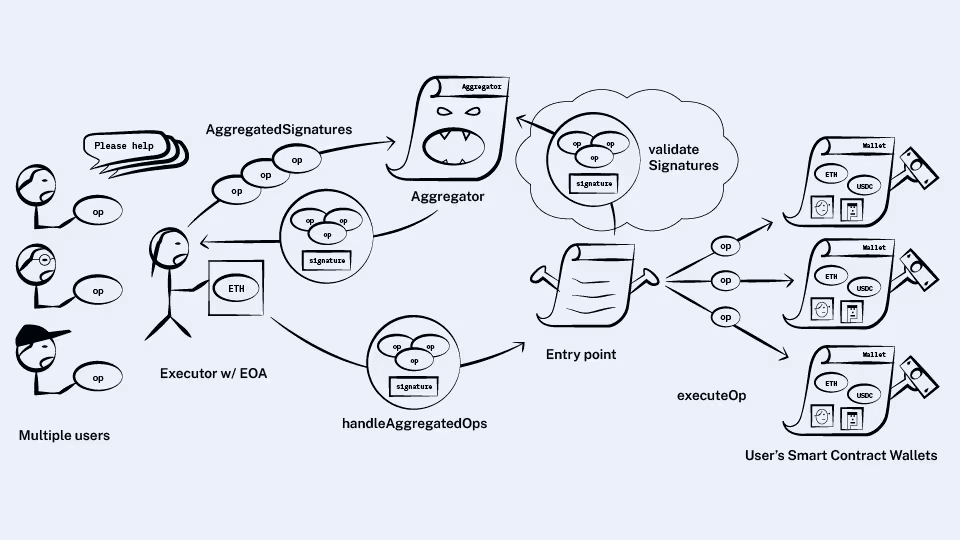
At the core of this architecture is the EntryPoint contract, which acts as the central hub for all user operations. When a user submits an operation, it is not immediately included in a block. Instead, it enters a mempool where bundlers compete to include it. The bundler then executes the operation against the EntryPoint. If the operation involves a paymaster, the EntryPoint verifies that the paymaster has pre-approved the transaction and has sufficient funds or stake to cover the gas. This verification happens before the transaction is finalized, ensuring that the gas cost is guaranteed without requiring the user to hold ETH.
This structure distinguishes sponsorship from account abstraction. Sponsorship is a specific use case where the paymaster pays for the transaction, often using ERC-20 tokens or covering costs as a marketing expense. Account abstraction, however, is the broader capability that allows any smart contract to act as an account, including the logic for who pays. The paymaster is one tool within this toolkit, enabling flexible payment methods while the account handles identity and access control. Understanding this flow is vital for implementing secure and efficient gasless experiences.
The relationship between the user, bundler, and paymaster creates a layered verification process. The user signs the operation, specifying the paymaster address and data. The bundler packages this with other operations and submits them to the EntryPoint. The EntryPoint then calls the paymaster's paymasterPreOp function to validate the sponsorship conditions. If valid, the paymaster's stake is locked, and the gas is refunded from the paymaster's deposit after execution. This ensures that the network is compensated even if the user's transaction fails due to logic errors.
Comparing 2026 Paymaster SDKs
Selecting the right ERC-4337 paymaster infrastructure depends on your chain coverage and integration complexity. In 2026, the market has consolidated around three primary providers: Pimlico, ZeroDev, and Biconomy. Each offers distinct advantages for developer experience and user abstraction.
Pimlico remains the standard for rapid integration, offering a unified API that abstracts the underlying bundler and paymaster logic. Their UserOperation validation is robust, supporting a wide range of EVM-compatible chains out of the box. This makes them ideal for teams prioritizing speed to market over deep customization.
ZeroDev focuses on the "smart wallet as a service" model, tightly coupling the paymaster with account abstraction logic. Their SDK simplifies the implementation of session keys and social recovery, which are critical for consumer-facing applications. While slightly more opinionated than Pimlico, their documentation and support for multi-chain deployment are highly regarded.
Biconomy offers a modular approach, allowing developers to pick and choose components like the paymaster, bundler, and account factory. This flexibility is valuable for projects requiring specific compliance or data privacy controls. However, the increased configuration overhead can slow down initial development compared to the all-in-one solutions.
| Provider | Integration Ease | Supported Chains | Architecture |
|---|---|---|---|
| Pimlico | High | 20+ EVM | Unified API |
| ZeroDev | Medium | 10+ EVM | Smart Wallet Service |
| Biconomy | Medium-High | 15+ EVM | Modular Components |


As an Amazon Associate, we may earn from qualifying purchases.
Gas Cost Structures and Limits
Understanding the financial mechanics of ERC-4337 sponsorship requires distinguishing between fixed limits and dynamic percentage models. The Paymaster Kit 2026 implementation calculates gas differently depending on whether the sponsor covers a hard cap or a variable share of the transaction cost. This distinction directly impacts treasury management and user experience.
Fixed Limit Sponsorship
Fixed limit sponsorship sets a maximum gas amount the paymaster will cover, typically measured in wei or gwei. This model is predictable for budgeting but rigid in execution. If the network congestion spikes and the transaction exceeds this limit, the user must pay the difference or the transaction reverts. This approach is best for stablecoin transfers or fixed-fee actions where gas consumption is highly predictable.
Percentage-Based Sponsorship
Percentage-based sponsorship allows the paymaster to cover a specific portion of the total gas cost, such as 50% or 100%. This model is more flexible, adapting to network volatility. However, it requires the smart account to handle the remaining balance. If the user’s account lacks sufficient ETH for the non-sponsored portion, the transaction fails. This model is ideal for high-value transactions where gas costs are a small fraction of the total value.
Calculating the Gas Limit
The gas limit is calculated by multiplying the estimated gas units by the gas price. For ERC-4337, this includes both the execution gas and the paymaster data gas. The Paymaster Kit 2026 provides tools to estimate these costs accurately, ensuring that the sponsorship covers the full transaction without over-allocating funds. Accurate estimation prevents underfunded transactions and reduces the risk of user frustration.
Security and validation logic
ERC-4337 introduces a new attack surface by decoupling transaction execution from fee payment. If the Paymaster logic is not rigorous, it becomes a liability rather than a utility. The core responsibility is to ensure that the Paymaster only sponsors operations that are valid, authorized, and free from replay attempts.
EntryPoint validation and signature integrity
The first line of defense is strict validation of the EntryPoint address. A Paymaster must reject any call originating from an address other than the deployed EntryPoint contract. This prevents malicious contracts from invoking your Paymaster directly to bypass fee logic or trigger unintended state changes.
Equally critical is the verification of the user’s signature. The Paymaster must reconstruct the user operation hash using the exact parameters provided in the UserOperation struct. If the signature does not match the user’s public key against this hash, the operation must be rejected. This step prevents signature forgery and ensures that the user explicitly authorized the specific transaction details.
Preventing replay attacks
Replay attacks occur when a valid transaction is executed multiple times. To prevent this, the Paymaster must check the nonce of the user’s smart account. The nonce should be unique for each operation. If a Paymaster accepts a nonce that has already been processed, it risks sponsoring duplicate transactions, leading to redundant gas costs or unintended state modifications.
For accounts that support batch operations, the nonce structure may differ. Ensure your logic accounts for the specific nonce format used by the account implementation. Consistency in nonce handling is vital to maintaining the integrity of the sponsorship process.
Ensuring operation validity
Beyond signature and nonce checks, the Paymaster must validate the broader context of the operation. This includes verifying that the user has sufficient balance to cover the fees (if required) and that the operation does not violate any business rules defined by your service. For example, if your Paymaster is tied to a specific token or loyalty program, you must ensure the user is eligible to use it.
This validation should happen before the Paymaster signs the transaction. By rejecting invalid operations early, you save gas for both the user and the Paymaster, and you protect your system from abuse. A robust Paymaster acts as a gatekeeper, ensuring that only legitimate and authorized operations proceed to the EntryPoint.
Implementation checklist for devs
Before deploying a paymaster in production, you must verify the core ERC-4337 entry point interactions. This checklist ensures your contract handles user operations correctly and funds are secure. Treat this as your final gate before mainnet exposure.
Ensure your paymaster targets the correct EntryPoint version (v0.6 or v0.7). Mismatched versions will cause silent failures or revert transactions. Test against the official entry point contract address for your target chain.

Simulate underfunded scenarios to verify your paymaster can cover gas without draining user funds. Ensure the postOp hook correctly refunds excess gas to the sponsor wallet. Incorrect logic here leads to lost funds or broken user experiences.
Confirm your paymaster correctly validates the user’s signature before executing the operation. This prevents unauthorized transactions. Use the same signature scheme (e.g., EIP-191 or EIP-712) as your smart account implementation.

Deploy to a testnet like Sepolia or Holesky. Send real test transactions through a bundler. Monitor the mempool to ensure your paymaster is correctly bundling and paying for the user’s gas fees.
Have your code reviewed by a security firm or experienced smart contract auditor. ERC-4337 paymasters handle financial assets; even small bugs can lead to significant losses. Do not skip this step.
No comments yet. Be the first to share your thoughts!