
Why gasless transactions matter now
In 2026, the requirement for users to hold native tokens for gas remains the single largest friction point in Web3 adoption. ERC-4337 account abstraction changes this dynamic by allowing smart accounts to sponsor transaction fees, effectively decoupling user interaction from blockchain network costs. This shift transforms the onboarding experience from a technical hurdle into a seamless consumer action.
The business case for gas sponsorship is rooted in user retention. When a user must acquire ETH or MATIC before making their first swap or mint, the drop-off rate spikes significantly. By sponsoring these initial transactions, protocols remove the barrier to entry, allowing users to focus on the application's utility rather than the underlying infrastructure. This approach mirrors the "free shipping" threshold in e-commerce: it removes a small, recurring friction point to drive larger, more frequent engagement.
MetaMask and other major wallet providers now natively support ERC-20 paymasters, enabling developers to implement gasless transactions where users pay fees in stablecoins like USDC or even the application's native token. This flexibility allows protocols to subsidize costs without forcing users to manage complex wallet top-ups. As smart contract wallets become the default interface for digital ownership, gasless transactions are no longer a luxury feature but a standard requirement for competitive user experience.
Choosing the right paymaster kit
Selecting an ERC-4337 paymaster implementation requires balancing developer complexity against user experience. In 2026, the landscape is defined by three primary approaches: account abstraction (AA) native wrappers, modular middleware, and full-stack SDKs. The right choice depends on whether your priority is gas estimation accuracy, supported token flexibility, or deployment speed.
| Kit / Approach | Dev Complexity | Token Support | Infrastructure |
|---|---|---|---|
| MetaMask AA Wrapper | Low | ERC-20 (e.g., USDC) | Managed (MetaMask) |
| Stackup / Alchemy | Medium | Multi-token via config | API Gateway |
| Biconomy / Particle | High | Native + ERC-20 | Relayer Network |
| Custom ERC-4337 | High | Any (Custom Logic) | Self-hosted |
MetaMask’s AA Wrapper is the simplest entry point for developers already embedded in the MetaMask ecosystem. It allows users to pay gas fees in ERC-20 tokens like USDC without requiring complex smart contract deployment. The trade-off is limited customization; you are bound by MetaMask’s gas estimation logic and token whitelists. This approach is ideal for prototyping or applications where user retention within the MetaMask wallet is the primary goal.
For broader compatibility, modular middleware providers like Stackup or Alchemy offer greater flexibility. These platforms provide API gateways that abstract the complexity of bundler interactions and user operation validation. They support multi-token gas payments through configurable rules, allowing you to swap between ERC-20 tokens or native ETH based on liquidity conditions. While this requires more integration effort than MetaMask’s wrapper, it offers a more robust path for production applications serving diverse user bases.
Full-stack SDKs such as Biconomy or Particle Network take a different approach, providing pre-built UI components and relayer networks. These kits often include "smart accounts" out of the box, simplifying the developer experience significantly. However, they introduce higher infrastructure dependency. You are relying on their relayer network for transaction inclusion, which can impact latency and cost depending on their operational efficiency. This model is best suited for teams prioritizing rapid development over granular control over the transaction lifecycle.


As an Amazon Associate, we may earn from qualifying purchases.
When evaluating these options, consider the gas estimation accuracy and infrastructure requirements. Native wrappers offer simplicity but lack the granular control needed for complex fee markets. Middleware provides a balance, while full-stack SDKs offer speed at the cost of vendor lock-in. For most production applications in 2026, a hybrid approach—using a middleware provider for core transaction routing while integrating specific UI kits for user onboarding—tends to deliver the best balance of control and developer velocity.
Integrating ERC-20 gas sponsorship
Enabling users to pay transaction fees in stablecoins like USDC requires configuring the Paymaster module to accept ERC-20 tokens instead of native ETH. This integration transforms the user experience by removing the need to hold native gas tokens, effectively decoupling the cost of operation from the asset used for value transfer.
The implementation relies on the PackedUserOperation structure defined in ERC-4337. When a user initiates a transaction, the callData contains the target contract and payload, while the paymasterAndData field encodes the payment method. The Paymaster contract validates the user's allowance and balance before signing the operation.
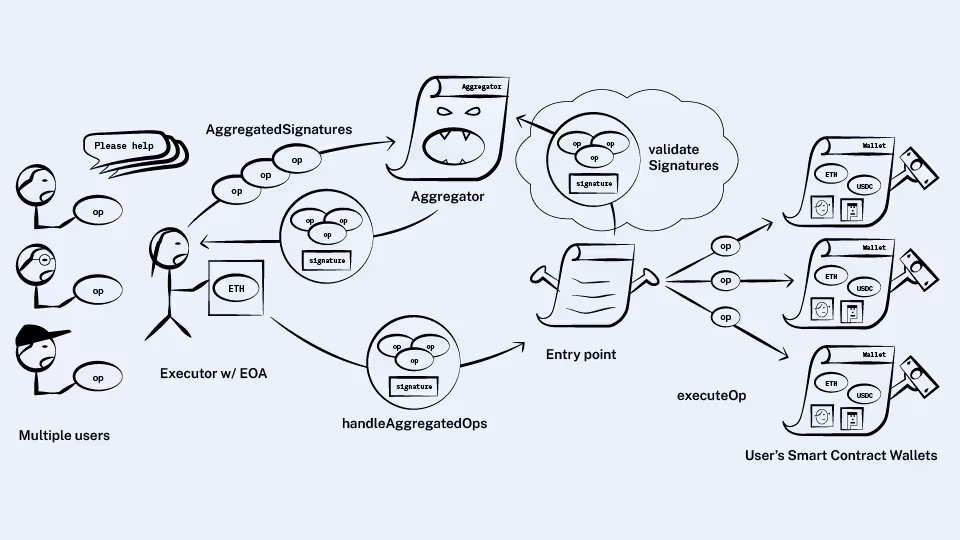
Before the Paymaster can deduct fees, the user must approve the contract to spend their USDC. This is a standard ERC-20 approve transaction. The approval amount should cover the estimated gas cost for the session or transaction batch. MetaMask Smart Accounts handle this approval flow seamlessly in the background if the user has previously authorized the Paymaster.
The client must encode the ERC-20 payment details into the paymasterAndData field of the PackedUserOperation. This typically includes a signature from the Paymaster and specific parameters indicating the token address and the amount to be deducted. The bundler reads this field to route the operation to the correct Paymaster contract for validation.
Once the bundler submits the operation to the Entry Point contract, the Paymaster's validatePaymasterUserOp function is called. The contract verifies the user's USDC balance and allowance, then records the debt. After the user's callData executes successfully, the Paymaster is responsible for settling the gas fees with the Entry Point, either by receiving native ETH from a sponsor or by transferring USDC from the user.
This flow shifts the friction of gas management from the user to the smart account infrastructure. By sponsoring gas in ERC-20 tokens, applications can abstract away the complexity of native token acquisition, making Web3 interactions feel as simple as traditional digital payments.
Managing smart contract wallet fees
Gasless transactions shift the economic burden from the user to the paymaster, but this model requires careful management of gas costs and subsidy strategies. Without proper controls, the paymaster can drain its treasury or leave users exposed to volatile gas spikes. Optimizing these costs involves balancing user experience with sustainable funding mechanisms.
Subsidizing gas costs
The most common approach is full sponsorship, where the paymaster covers all gas fees for specific operations. This creates a frictionless onboarding experience but requires the paymaster to hold sufficient ETH or native tokens. To manage this, paymasters often implement gas limits per transaction or daily caps per user address. This prevents abuse and ensures that the subsidy remains predictable.
User reimbursement models
For high-frequency users, full sponsorship can become unsustainable. A reimbursement model allows users to pay gas in ERC-20 tokens rather than the native chain currency. The paymaster collects the token fees and uses them to purchase native gas on-chain or via a dedicated liquidity pool. This decouples the user's spending from gas price volatility and allows the paymaster to subsidize specific token pairs.
Monitoring gas prices
Gas costs fluctuate based on network congestion. Integrating live market data helps paymasters set dynamic gas limits. By monitoring current gas prices, the paymaster can adjust its subsidy strategy in real-time, ensuring it doesn't overpay during peak times or under-collect during lulls.
Checklist for gas management
-
Set maximum gas limits per transaction to prevent runaway costs.
-
Implement user-level daily caps to prevent treasury drain.
-
Choose between full sponsorship or ERC-20 reimbursement based on user base.
-
Monitor live gas prices to adjust subsidy parameters dynamically.
-
Test gas estimation logic under high network congestion scenarios.
Common integration pitfalls to avoid
Even with a robust ERC-4337 Paymaster Kit, several technical risks can silently break the gasless user experience. The most frequent culprit is signature expiry. User signatures must be validated against the entry point contract before submission to the bundler to prevent failed transactions. If the user’s wallet takes too long to sign or the network is congested, the signature may expire before the bundler processes the user operation (UserOp). Always implement strict validation checks to reject expired signatures early, avoiding unnecessary gas burns.
Gas limit miscalculations present another significant hurdle. Paymasters must estimate the total execution cost, including the user’s actual transaction and the paymaster’s overhead. Underestimating this limit causes the UserOp to revert, while overestimating wastes funds. Use dynamic gas estimation based on current network conditions rather than static values. This ensures the transaction completes reliably without excessive costs.
Bundler reliability issues can also disrupt service. Not all bundlers handle UserOps with equal efficiency. Some may drop transactions or delay processing during high traffic. Integrate fallback bundlers or use a bundler aggregator to maintain uptime. Monitor bundler performance metrics and switch providers automatically if latency exceeds acceptable thresholds. This proactive approach keeps your gasless feature running smoothly for end users.
No comments yet. Be the first to share your thoughts!